








There’s something about the ocean that doesn’t ask for your attention.
It doesn’t try to impress you.
It doesn’t compete for your focus.
It just exists.
And somehow, that’s enough.
The First Moment by the Water
When you arrive at a coastal place—whether it’s a quiet shoreline or a long stretch of open beach—there’s always a pause.
You stop.
Not because you planned to.
But because something shifts.
The sound of the waves.
The movement of the horizon.
The openness of everything in front of you.
It pulls you out of whatever pace you were moving at.
And replaces it with something slower.
Space Changes the Experience
Cities are dense. They surround you. They demand attention.
The ocean does the opposite.
It gives you space.
Endless, uninterrupted space.
Standing on a coastline in California, looking out over the Pacific, there’s a sense of scale that’s hard to ignore. You’re not just looking at water—you’re looking at distance, depth, and something that continues far beyond what you can see.
That kind of openness changes how you feel.
It quiets things down.
The Rhythm of the Ocean
Unlike cities, the ocean doesn’t rush.
Waves come in.
Waves go out.
Again and again.
There’s no urgency.
And when you stay long enough, you start to match that rhythm.
You walk slower.
You think less about what’s next.
You stop trying to fill every moment.
Places like Malibu carry that rhythm naturally. You don’t have to force it. It’s already there, built into the environment.
All you have to do is stop resisting it.
Being Present Without Trying
Most environments require effort to stay present.
You have to remind yourself to slow down.
To notice things.
To disconnect.
At the ocean, that effort fades.
The simplicity of the setting does the work for you.
There are fewer distractions.
Fewer decisions.
Less noise.
You sit.
You watch.
You listen.
And without realizing it, you’re fully there.
The Details You Don’t Expect
At first, the ocean feels simple.
Water. Sand. Sky.
But the longer you stay, the more you notice:
- The changing color of the water throughout the day
- The patterns left behind by the tide
- The way light reflects differently as the sun moves
These details aren’t obvious.
They reveal themselves slowly.
And that’s what makes the experience deeper than it looks.
Solitude Feels Different Here
Being alone in a city can feel isolating.
Being alone by the ocean feels different.
It feels intentional.
There’s something about the openness that makes solitude feel lighter.
Less like absence.
More like space.
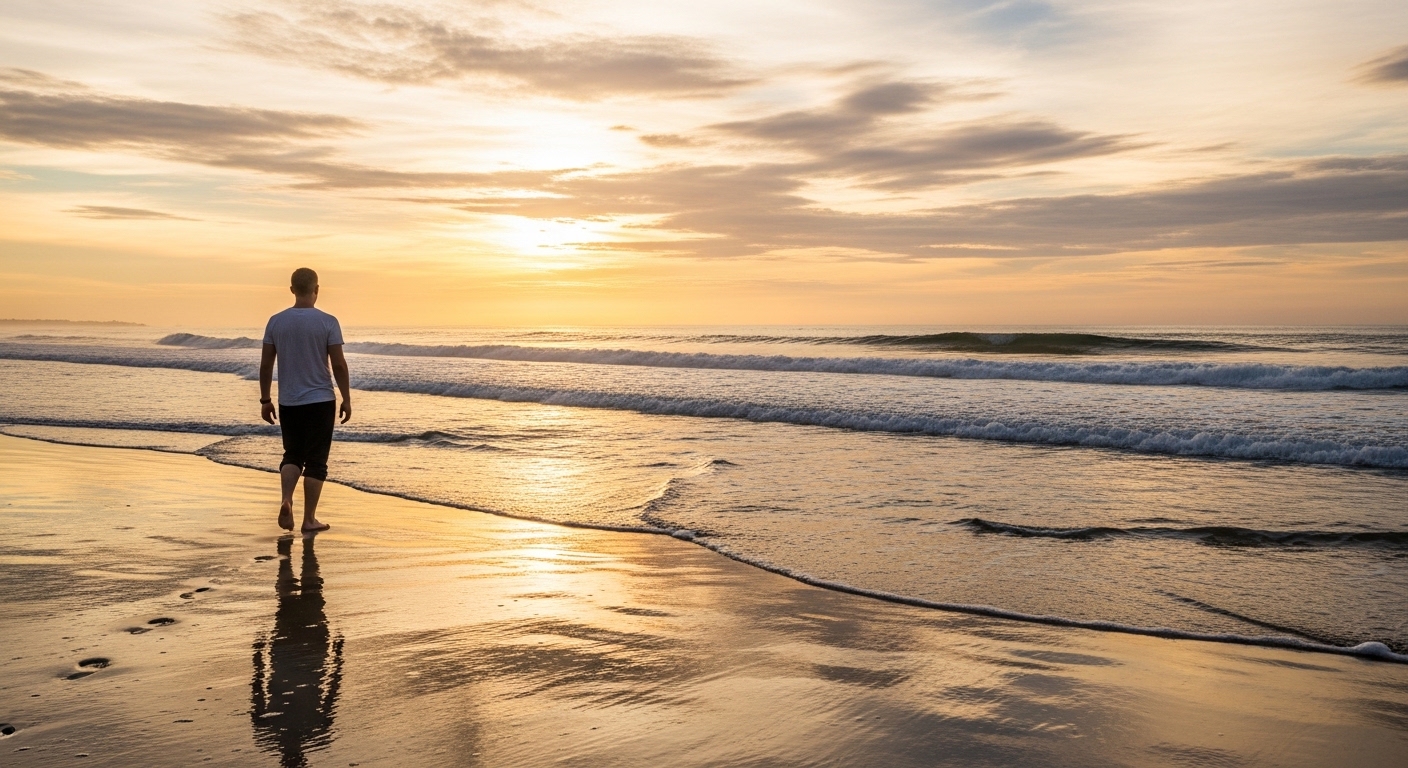
Walking along a quiet beach, especially during early morning or late evening, creates a kind of clarity that’s hard to find elsewhere.
You’re not distracted.
You’re not overwhelmed.
You’re just there—with your thoughts, but not consumed by them.
Time Moves Differently
At the ocean, time doesn’t feel structured.
You don’t check it as often.
You don’t measure it the same way.
An hour can pass without you noticing.
Because nothing is pushing you forward.
In places like Santa Monica, even with people around, there’s still a sense of looseness. People move, but not with urgency. They stay, but without pressure.
That shift in time changes the experience.
You stop rushing through it.
Why It Stays With You
Ocean experiences don’t rely on intensity.
They don’t overwhelm you with activity or constant stimulation.
They stay because they create balance.
They give you something most environments don’t:
Stillness.
And in that stillness, things settle.
Thoughts become clearer.
Feelings become quieter.
Moments become more defined.
Final Thought
Not every travel experience needs to be full.
Some of the most meaningful ones come from space.
From slowing down.
From doing less.
From allowing the environment to shape the moment instead of trying to control it.
The ocean doesn’t change for you.
But if you let it…
it changes how you experience everything else.